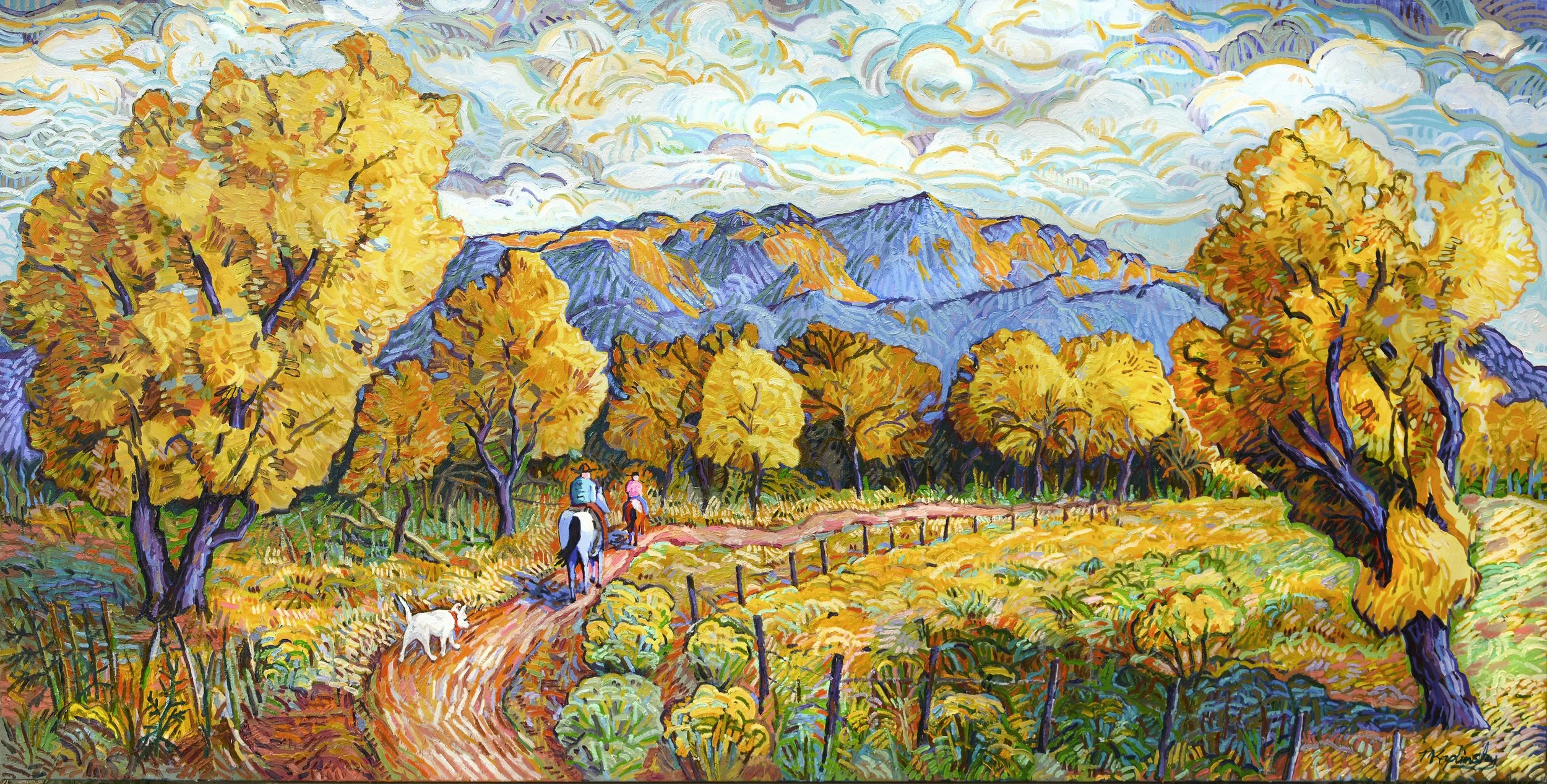
Artistic Approach:Many collectors take into consideration the artists’ approach to making the work that the artist produces. Matt’s artistic approach is to break things down into shapes and colors.
For Matt Kaplinsky, it begins by acknowledging general areas or fields of color. In his work the initial “blocking in” of colors and shapes is critical. Then the pieces of the image are “built” with a construction method of using small imaginary ‘sticks’ of color. These ‘sticks’ may also just be swipes of color onto another or even into another if the paint is being worked as a wet-on-wet layer. Sometimes you can even see where the paint was intentionally mixed right on the canvas in this way, often as though he were rushed. Matt’s way of seeing illustrates how everything we look at is just combinations of color on color, and how in anything’s basic form it is just shapes and colors.
Essentials:MATT KAPLINSKY
*Artist Statement:
My current work explores a style that might be described as 'folksy impressionism', with a focus more on the mark making with the paint. Photos I take on my travels serve as inspiration; their cropped views transform remembered images, allowing me to reinvent them. Using a style of impressionism my colorful paintings on canvas convey a feeling about viewing a space-It’s about seeing- whether seen up close, as a still life subject, or experienced as a broad vista of landscape.
*Bio:
Matt Kaplinsky is a professional American impressionist painter based in North Texas, specializing in original oil paintings of the American Southwest and West. His work explores Southwestern landscapes, Western scenery, horses, and riders through expressive brushwork, distinctive color relationships, and an impressionistic interpretation of light, atmosphere, and place. His paintings offer a contemporary perspective on the landscapes and traditions of the American West. His work is represented by galleries throughout the Southwest.
Born in Dallas, Texas, in 1968, Kaplinsky developed an early interest in the natural world and the gardens of his childhood. His parents cultivated extensive gardens and raised Arabian horses. Between working in the family gardens and visiting horse ranches, Matt developed an appreciation for the commonalities of structure and form found throughout nature. These early experiences would influence many of his interests and artistic decisions throughout his life. He continued drawing and painting while independently teaching himself to work in a variety of mediums. Today, he primarily works in oil, creating original paintings inspired largely by the American Southwest, the natural world, and the visual experience of a place.
In 1991, Kaplinsky was introduced to a locally known art critic who suggested that he audit an Art History class the critic taught at a prestigious university. After attending the first class, Kaplinsky quietly slipped into the front rows of the lecture hall for the remainder of the semester. The experience proved to be a pivotal moment, opening his eyes to the possibilities of art and painting. As he began considering his own approach to applying paint, he realized that a painting could be built, so to speak, from individual sticks of color. From that point forward, he made a concerted effort to study the work of nineteenth- and twentieth-century painters as closely as possible, traveling to exhibitions across the country and examining, in particular, how paint was applied to canvas. Over time, this study became fundamental to the development of his distinctive brushwork.
Over the next three decades, Kaplinsky continued exploring the importance of mark-making and leaving evidence of the artist's hand throughout the canvas. He believes that every inch of a painting should at least be considered, if not actively worked with paint. Working from both memory and photographs, he draws upon experiences in places as varied as the high mesas of New Mexico, the dramatic sea and sky of coastal Maine, and the cloud forests of Costa Rica. His artistic influences have evolved over time and include David Bates, John Alexander, Robert Daughters, Marsden Hartley, Bonnard, Matisse, Van Gogh, Monet, and many others. Travels throughout the United States and abroad continue to provide inspiration for his work. As Kaplinsky puts it, "For me, the important thing about art is what you take from it—both upon its viewing and afterwards."
Although Kaplinsky began painting in 1991, it was not until 1997 that he began selling his work through commercial venues. In 2003, he held his first solo exhibition at a Dallas gallery, where he sold thirty of the thirty-four paintings exhibited. Over the years, his work has evolved through several distinct bodies of work, beginning with landscapes before expanding into still life and paintings inspired by familiar subjects close to home. For a time, his attention focused on the intimate details of everyday surroundings, from a branch on a pear tree to subjects found in his own backyard.
A 1998 trip to northern New Mexico proved particularly influential, providing an abundance of inspiration that would eventually lead him back toward the landscapes of the American West. Subsequent travels to Washington State, Massachusetts, and Maine further expanded his visual interests. Ongoing friendships and connections throughout the Southwest have continued to inspire paintings of Colorado, New Mexico, Texas, and Arizona. Today, his work is represented by galleries throughout these regions.
Kaplinsky continues to maintain an active and prolific painting practice. While much of his recent work focuses on the landscapes and subjects of the American Southwest and West, his eye continues to wander toward the rocky shores and forests of Maine, the mountains of Colorado, the distinctive landscapes of Utah, and countless other destinations across America. These varied experiences remain an ongoing source of inspiration for his evolving body of work.
Kaplinsky's paintings are included in corporate and private collections around the world. Original works are available through his gallery representatives, and commissions may be arranged through those galleries.